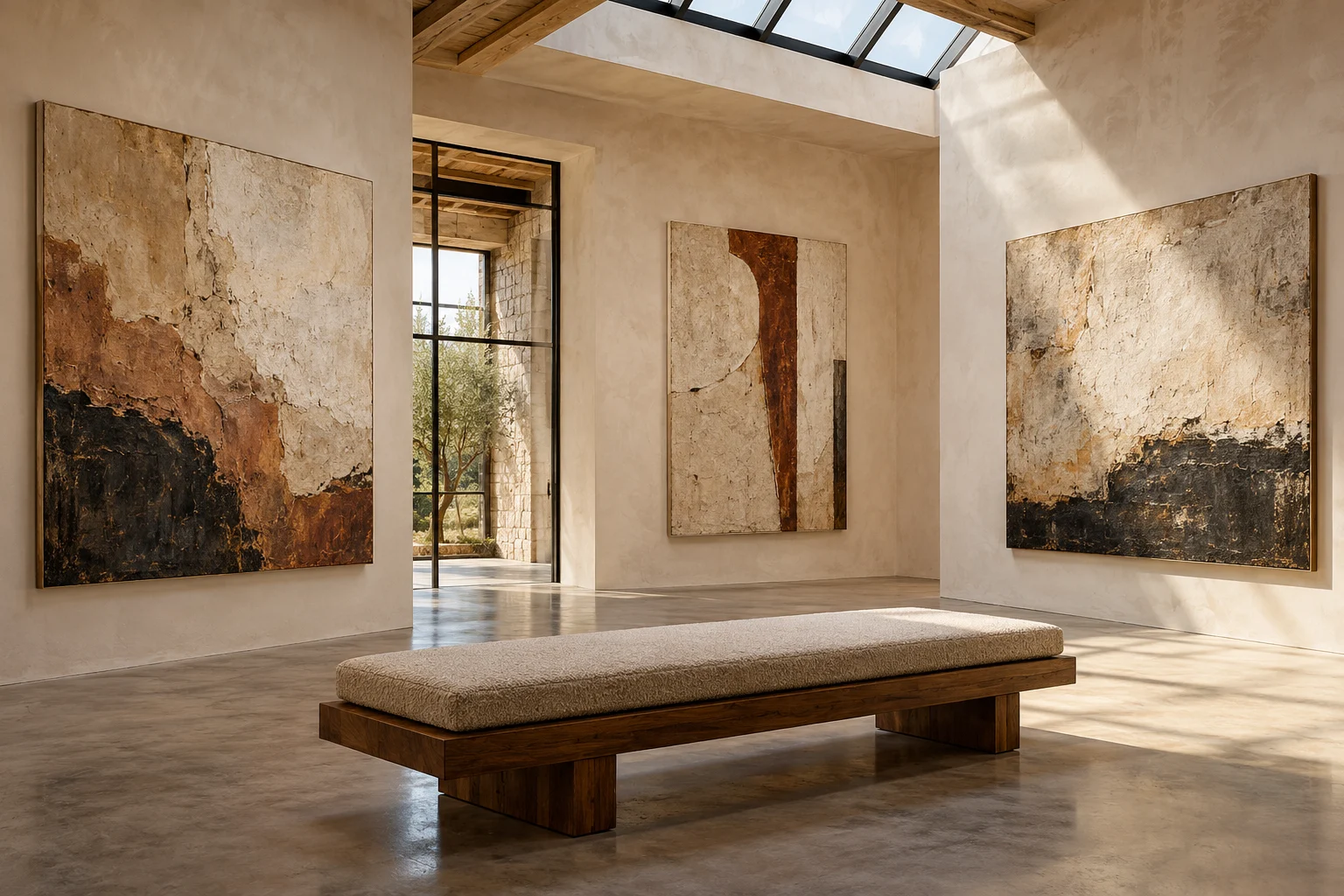
A heavy canvas hangs on a white wall, dominated by thick, jagged strokes of ochre and deep violet. You find yourself leaning in, noticing how the paint catches the light in some ridges while pooling in others. To one person, these shapes might suggest a violent storm; to another, they might look like the quiet shadows of a canyon at dusk. Your immediate reaction—that gut feeling of warmth, unease, or curiosity—is a valid starting point for any encounter with art.
The Gap Between Sight and Statement
It is common to feel a sense of hesitation when walking through a gallery, as if there is a hidden test waiting to be passed. Often, a small plaque near the work provides the artist’s intent, explaining the specific history or emotion behind the piece. While these descriptions offer context, they exist alongside your own visual experience rather than replacing it. There is a distinct difference between observing the physical properties of a work—the texture, the scale, the color temperature—and absorbing the creator's stated narrative.
One approach is to hold both perspectives at once. You might notice a sense of isolation in a painting's composition, only to read that the artist was actually depicting a celebratory gathering. This tension between your observation and the provided explanation does not mean you have misunderstood the work; it simply means you are having a personal dialogue with the object.
Testing the Waters of Appreciation
If the idea of a formal museum visit feels overwhelming, you might consider a more modest entry point. For example, if you are curious about local art but wary of the hushed, intimidating atmosphere of major institutions, you could visit a small neighborhood studio or a community center display. These smaller settings often allow for a more relaxed pace where you can linger over a single piece without the pressure of a crowd.
The tradeoff in these smaller venues is often the depth of technical documentation. A large museum might provide extensive scholarly essays, whereas a local studio might offer only a brief note. However, the smaller setting provides the freedom to move at your own speed. You can decide which pieces demand your attention and which ones you can pass by without feeling as though you are missing a required lesson.
Preparing Your Perspective
When you decide to engage more deeply, you can prepare by focusing on your own sensory responses. Instead of searching for a "correct" interpretation, try to identify specific elements that draw your eye. Ask yourself why a certain color choice feels heavy or why a particular line feels energetic. If you find yourself speaking with a curator or a gallery guide, you might ask how the artist’s chosen materials contribute to the overall mood of the collection. By focusing on what you actually see, you turn the experience from a search for answers into a personal observation of form and feeling.